
Sweet Afternoon brings together round motifs, bird-shaped spoons and decorative centerpieces in one Mahjong design. A closer look reveals the connections: curved outlines, small details inside larger shapes, and red, blue-green and olive accents that return across the suits.
This time, the focus is on the visual details themselves. Instead of starting with a complete table setting, look at two tile faces at a time. A small pattern becomes easier to notice when it has room around it.
Round motifs with rings inside
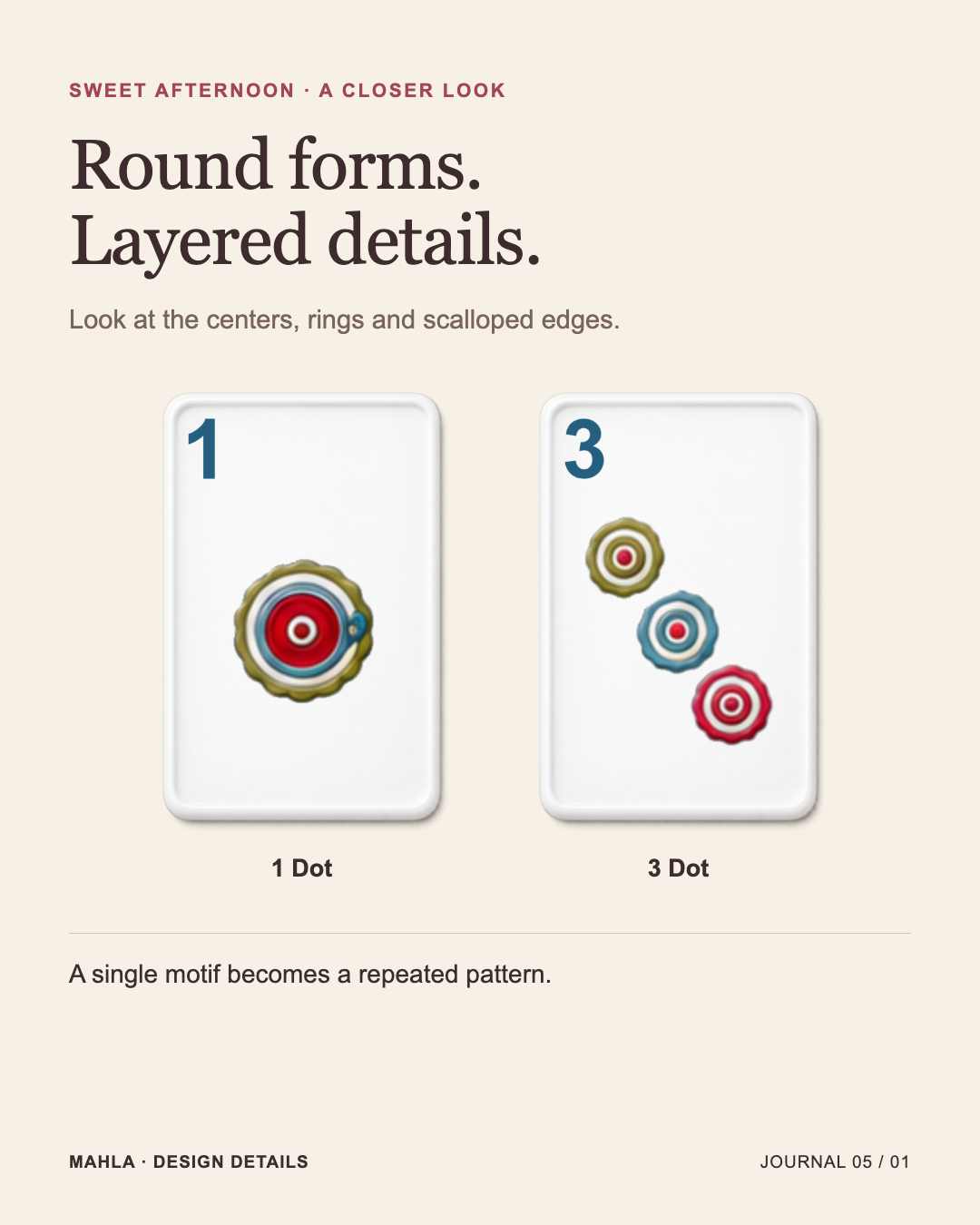
The Dots use round forms with outlined centers and scalloped edges. On 1 Dot, one large motif fills the middle of the face. On 3 Dot, three smaller motifs form a diagonal arrangement, each with its own center and border.
The layered rings can bring a decorated saucer to mind. That is a visual association: the design remains a Dot tile, and the rings are details within one complete motif. The red centers and blue-green or olive surrounds give the small circles a connection to the palette elsewhere in the set.
A bird-shaped spoon changes the silhouette
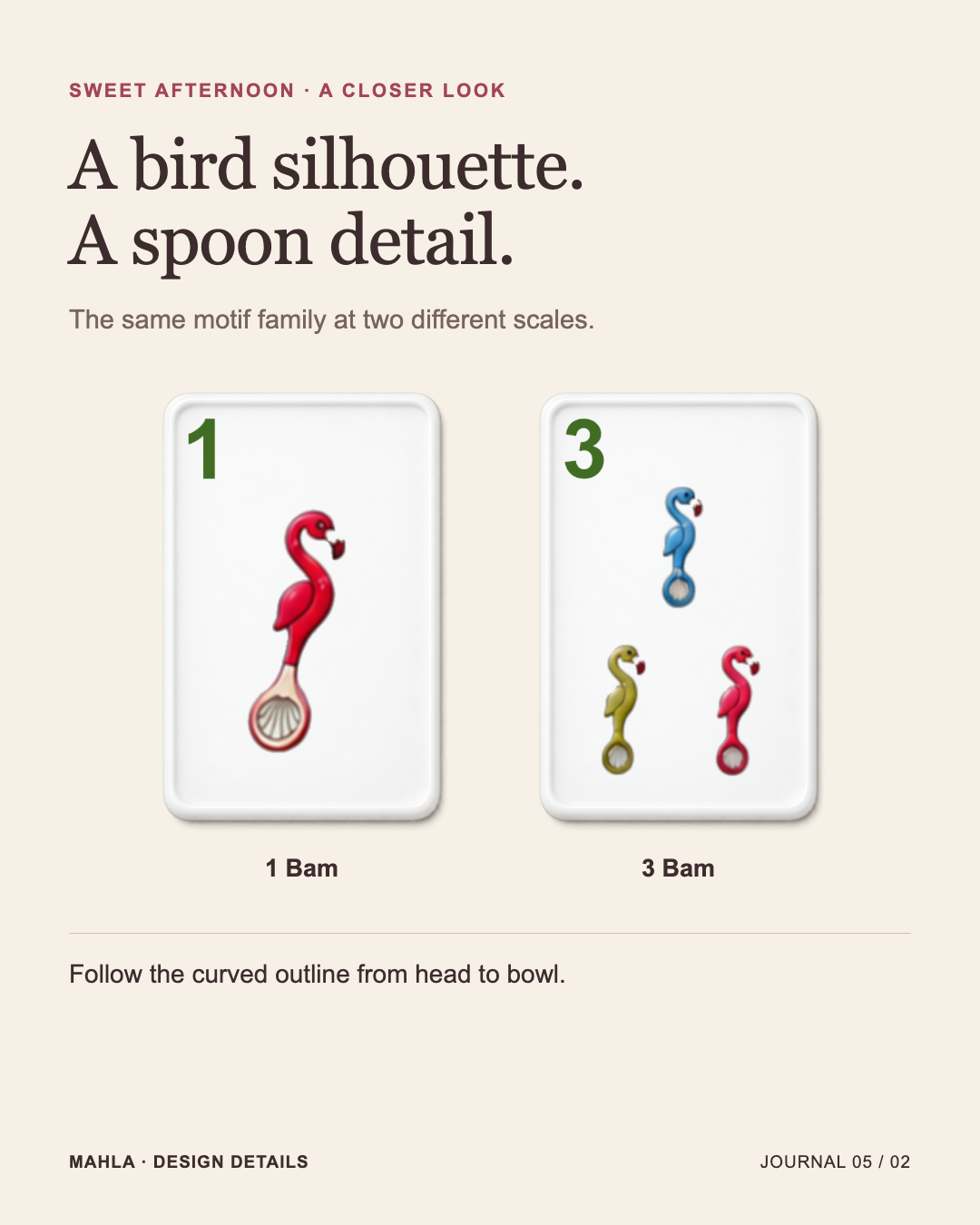
The Bam examples move from circles to a taller, curved shape. On 1 Bam, the bird’s head and bent neck lead down to the spoon’s bowl. On 3 Bam, three smaller bird-shaped forms repeat the long silhouette in different colors.
That change of scale gives two different views of the same motif family. The single large form makes the outline and bowl detail prominent; the three smaller forms make repetition and the spaces between them more noticeable. Both belong to Sweet Afternoon’s particular design language.
A centerpiece frames the Crak numeral
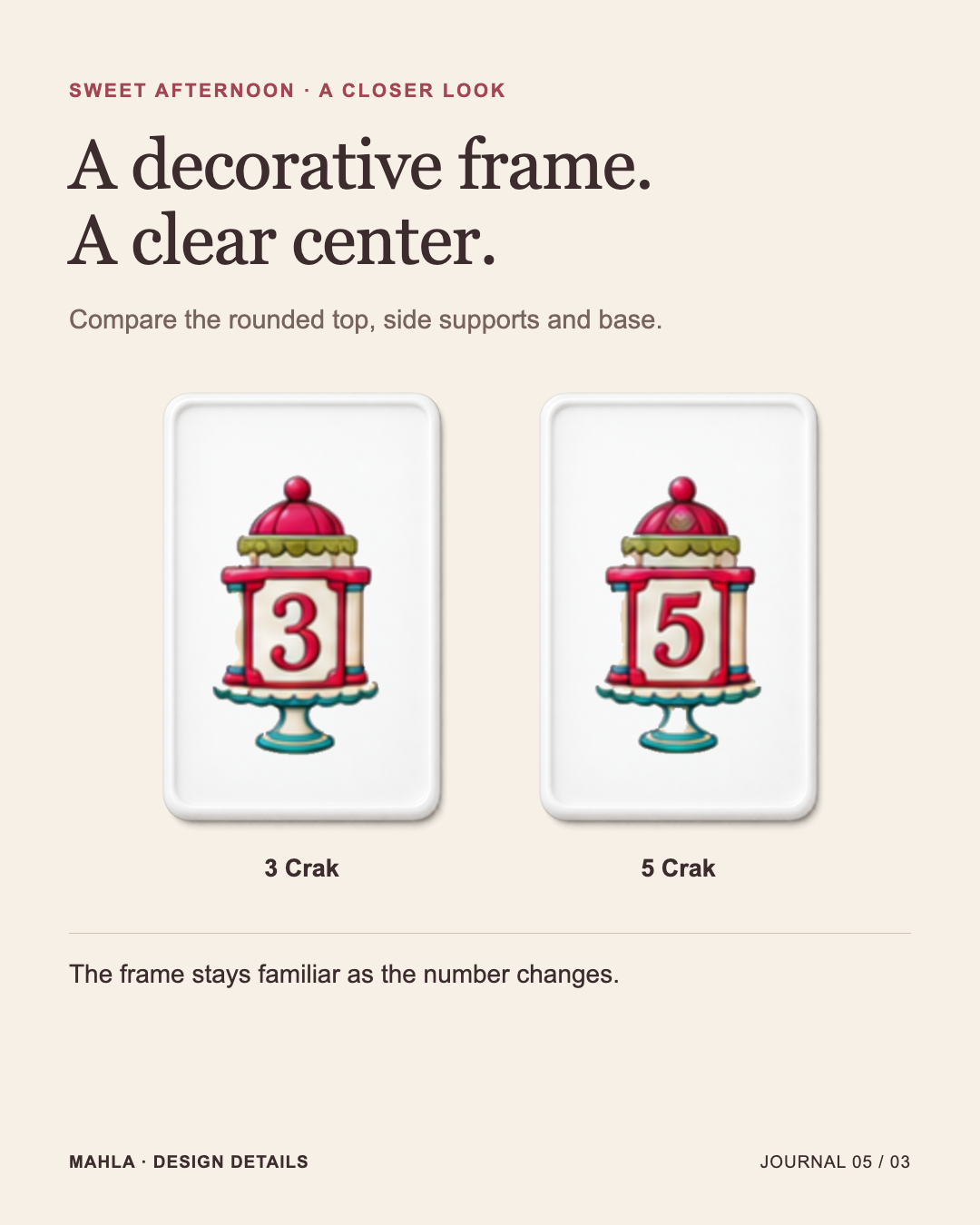
The Craks have a more architectural outline: a rounded top, scalloped trim, side supports and a pedestal-like base. The large numeral sits inside that structure. Comparing 3 Crak and 5 Crak shows how much of the decorative frame stays familiar while the number changes.
Here, the tea-table association comes through the raised, ornamental centerpiece. Red forms draw attention to the top and numeral, blue-green returns at the base, and olive appears in the trim. Those are visible color relationships, rather than a claim that every detail represents a specific object.
One palette, different shapes
The connection across these faces does not depend on making every suit look the same. Dots remain round, Bams use the bird-shaped spoon silhouette, and Craks place a large number within a centerpiece. Curves, outlined details and recurring colors help the examples sit together on the pale tile faces.
For a closer look at the collection, visit Sweet Afternoon. If you are learning the tile names, our Dots, Bams and Craks lesson is a useful companion.
A small observation to try: choose two faces and follow just one feature—the curved outline, the red accent or the framed center. Which detail do you notice first?